
A Quick Guide to Photographing Yourself
Thank you for trusting me with something so personal. This piece of art will be a transformation of you, into something both familiar and a little otherworldly. To bring your portrait to life as accurately as possible, I’ll need a few reference photos of you. This guide will walk you through how to capture images that feel natural, so your final artwork holds both your likeness and a sense of surreal magic.
Lighting (this is the most important part)
Please photograph yourself in soft, natural light.
The best options are:
Standing beside a large window or open doorway
Standing outside in the shade (under a patio, tree, or awning)
Try to avoid:
Direct sunlight hitting your face or body (this creates harsh shadows)
Overhead lighting or indoor artificial lights
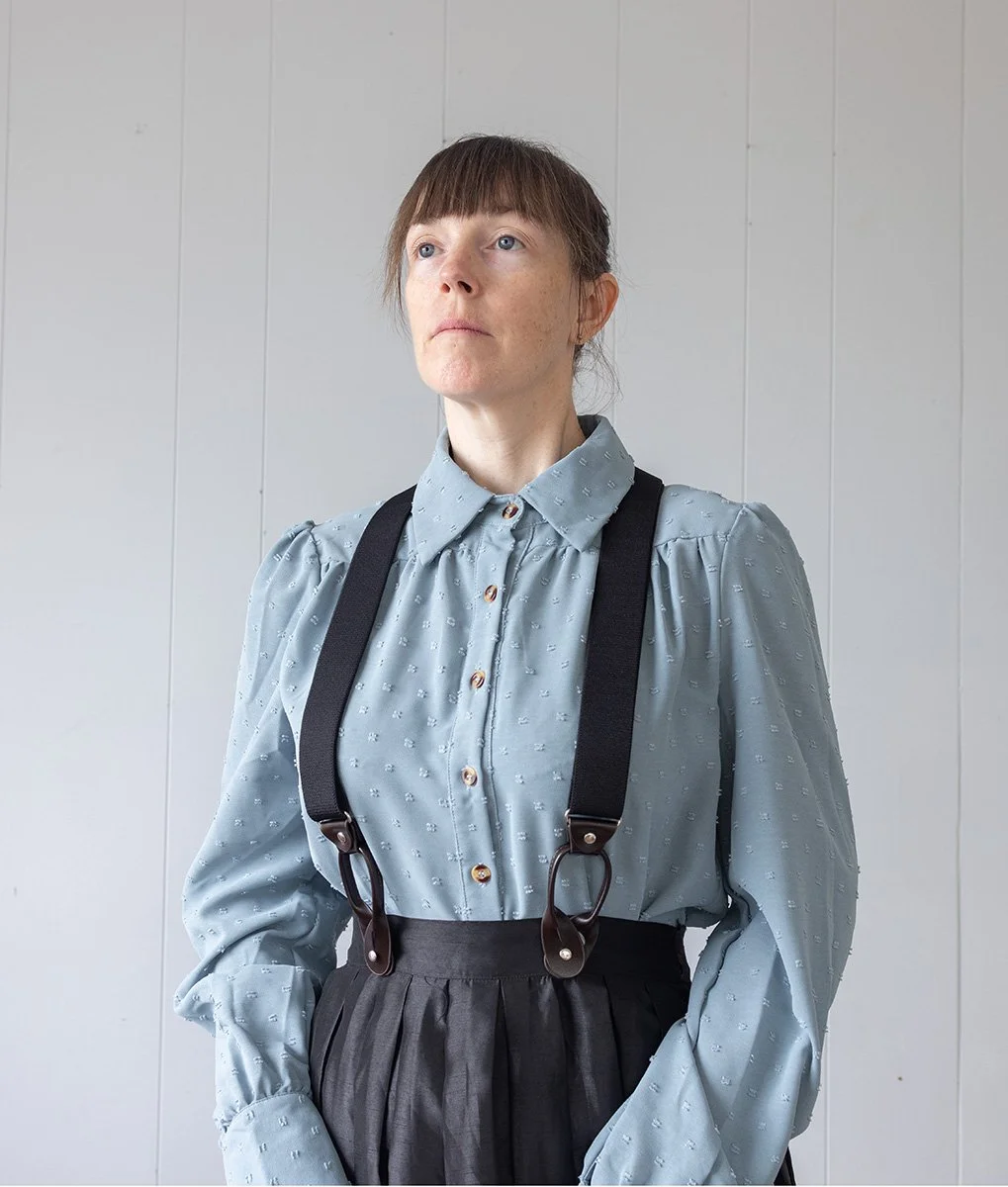
We’re aiming for gentle, even light that softly wraps around you. The best time of day for this is in the morning, during sunrise, or the late afternoon as the sun is setting. If it’s an overcast day, then any time is fine. Refer to the photograph of me. I took this in my studio, standing next to a large window to my right that lets in a lot of natural light.
Positioning & Angle
Stand facing the light source (window/door/open sky)
Keep your body relaxed and natural
The camera should be held at about chest or neck level
Avoid dramatic angles - straight-on or slightly turned is perfect
You’re welcome to send a few variations (slight turns, different poses) so I can choose what feels most aligned with the piece. Please refer to the photograph of myself as reference. As you can see, the light is coming through a large window to my right. I’ve angled myself toward that light, and I’ve positioned myself on a slight angle to the camera, rather than straight on. The camera was positioned on a tripod around chest height.
If you’re a couple, consider how you’d like to pose together, whether that be side by side, or one person slightly in front of the other. You could even be facing each other. This is entirely up to you as a couple. Feel free to try several poses and send them all my way.
Framing the Photo
Please refer to the photograph above as reference. Ideally, I need photos from about your hips up. Make sure your shoulders and upper body are clearly visible. Leave a little space above your shoulders (even though your head will be replaced). It’s best to photograph yourself against a blank wall / closed door if possible. Try to avoid an overly busy background.
Expression & Feeling
You don’t need to “pose perfectly.” You can clearly see by my face in the reference image I wasn’t stressed over my facial expression. Since your head will be replaced don’t worry about your face. A soft, neutral expression or a subtle emotion you resonate with is perfect.
Try to relax your body. Think of it as capturing a quiet moment rather than performing for the camera. Other than me, no one else will see these pictures, and I promise I’ll be deleting them after I’m done painting your object-head portrait.
What to Wear
Wear something that feels like you. Soft textures, simple silhouettes, and pieces you feel comfortable in tend to translate beautifully into the final artwork.
Try to avoid:
Overly busy patterns or logos that are distracting
Very dark clothing that loses too much detail
If you’re unsure, feel free to send me pictures of what you have and we can figure it out together.
Hair (Important)
Because your portrait will be transformed into an object-head piece:
If you have long hair, please tie it back into a bun
Keep your hair off your neck and shoulders as best you can, but don’t stress about little fly-aways
This allows me to clearly reference what part of you I need to paint, and helps me create a seamless transition into your object-head form.
Your Object
Depending on what your object is, and if you physically have the object, I recommend getting a photo of this as well. Take the photo at the same angle / lighting, and hold it around head height when capturing it so I can easily align it with the photo of you.
Sending Your Photos
Please send 3–6 photos that are clear, high-resolution images (phone photos are perfectly fine, unless your phone is ancient, in which case, phone a friend with a good quality phone and ask them to borrow it).
You can email them to: hello@charlisavage.com.au